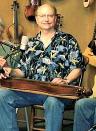
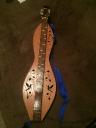
How do I tune this Bass Dulcimer?
General mountain dulcimer or music discussions
Blevins dulcimer
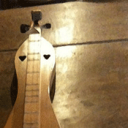
WOW, very nice
yes, how does it sound
Blevins dulcimer
WOW, very nice
yes, how does it sound
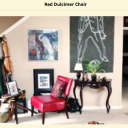
I have little grandchildren; so when I was looking for a chair for playing the dulcimer, I also was thinking of extra space for extra little angles. It is low & no arms, just a bit too deep but I place a pillow & all is good.
oh I ment to add....I made the folding legs of the now wooden dulcimer table to a very low position that it's at "lap height" for me. I know I SHOULD play the dulcimer on my lap and knees, but I love the sound of it on a table. I have some little "stick on" little feet and the whole dulcimer vibrates nicely. I think she's happiest on the table. That table is 23 & 1/2 inches tall. aloha, irene
I use an 18 inch tall stool I made a long time ago, but I put my dulcimer on a table that I got from Walmart, took off the plastic top and put on a nice wood top. I have it so it folds up. I'm looking for a chair that folds up too, but would like a comfortable wide one. I've repaired and made some very cute cushions for those piano stools. Sold one for $175.00.
I use a triangular folding camp stool with a back when playing sitting.
Hey Ken, I've been hearing a lot about those. I don't think they're quite my thing, but this is an interesting discussion here on fotmd. thanks.
I think I play best in my recliner with the dulcimer across the arms....
Hi Jan! Nice to chat with you. I know somebody else who plays with the dulcimer on the arms of a chair. Helps the sound ring out too!
Hi Mary, I use a couple different seats. One is an old round wooden piano stool where the seat spins up and down. But it's lowest position is about 18" and has no back. My other chair is what I call a "steno" office chair. It's has a padded seat and back and it adjusts to various heights by a lever. It has no arms and the lowest position is 16". I got it at an office supply store on a close -out for $25. It's on wheels, doesn't take up much room and is very comfortable. It also doubles as my sewing chair at the sewing machine. This chair is also easy on the fanny whereas the stool is not. Dulcinina
Hi Dulcinina, thanks for commenting! I think I'll ultimately go for one of those office chairs. Funny coincidence, but I also have an old piano stool that spins! It was my grandma's, so it is old. I don't ever really use it for anything... and I think I'd need more cushioning for my rear end anyway 
I'm trying to get back into playing my dulcimers. I have 3 that I've had for years. I've restrung all 3. One of them, built by a well-respected luthier, sings too long. That is, the sound goes on for a good 8 seconds after my hands have left the instrument, and it's distracting. When I put my hand on the wood, the sound stops. I don't want a choppy cut-off, but this is too much. I suspect I've done something wrong with the re-stringing. Any ideas? The other two don't do this. I have had the strings for a while, but they were in their original envelopes.
Trevor, I'm thinking that what you are actually asking about is this: you are going to look at Group discussions (not Forum discussions) and are seeing only the original post but not the replies by others. That's because you need to JOIN that Group in order to see the entire discussion including the various replies, and you'll also need to JOIN that Group in order to make a post in it. If you click to such a discussion, notice if it's a Group discussion, and if so, then simply JOIN that group and you'll then see all the replies as well as the original post for that Group's discussions.
I think I play best in my recliner with the dulcimer across the arms....
I use a triangular folding camp stool with a back when playing sitting.
Hi Mary, I use a couple different seats. One is an old round wooden piano stool where the seat spins up and down. But it's lowest position is about 18" and has no back. My other chair is what I call a "steno" office chair. It's has a padded seat and back and it adjusts to various heights by a lever. It has no arms and the lowest position is 16". I got it at an office supply store on a close -out for $25. It's on wheels, doesn't take up much room and is very comfortable. It also doubles as my sewing chair at the sewing machine. This chair is also easy on the fanny whereas the stool is not. Dulcinina
Hi all!
I'm looking for a chair for playing at home. I seem to need something no more than 16 inches high, no arms (of course) and a back for relaxing. Do you have any favorite seats? Maybe I'll like what you like!
Sorry I've been away from fotmd for so long... My daughter had twins a year ago and life has been BUSY! (and when she had the twins, her other two were 1 and 3 yrs old! Not complaining though. It's been a good time for this grandma!
  I might start actually playing and singing again soon now that we all survived that first year!!! I've missed you folks!
Hi again, fellow compulsive dulcimer purchaser! I have a question on this Blevins dulcimer you bought. How does it sound by now? Is the intonation good? Is the sound full or tinny? Thanks!
('mountain dulcimer abuse')
No, more like another way of letting the strings ring.
(over the strum hollow for good clean strikes that don't knock wood.)
Ha, yes. I learned this quick enough. (Little Drummer Boy ) that does sound like it would be a good one for this technique.
Thanks, as always
A friend just picked up this instrument. The fret markers and soundholes are unique. No label inside, but "P.L. Purser Wareham, Mass" is on the headstock... Evidence points to this being built in the 1960s/70s
https://www.facebook.com/photo.php?fbid=10212114415550201&set=a.1478176308940.63482.1069737994&type=3
They are your cigar boxes, do with them as you please. I think most builders keep them right side up to show off the cigar makers labels and such. Either way around, the insides certainly can be used for storage; but as you say, you do need to insure that they don't open spontaneously.
Technique works really well for Little Drummer Boy and a couple other tunes I know. You do have to keep the 'hammer' over the strum hollow for good clean strikes that don't knock wood.
I'm very tempted to call this 'mountain dulcimer abuse'
I am revisiting hammering the dulcimer strings instead of strumming. I have a wooden dulcimer hammer but it doesn't ring when I hit the strings as does a chopstick, a paintbrush, a leader drum stick and a brass tube over a stick. I think maybe the wooden hammer just isn't heavy like the others. I am only playing slow, easy songs to start with but do like the different sound of hitting vs. strumming with some songs. Again, the different dulcimers, size, wood, etc. sound different with hitting & each has it's own tone.
Any suggestions for hammering? Not thinking anything serious just playing around.
I did find 3 cigar boxes that match up. I needed to go to several shops, there isn't as many cigar shops now but smoke shops. The boxes are not deep but they are made of wood. I did see some beautiful wood ones but couldn't find 3 that fit together.
I was thinking of turning them upstairs, seems to be a smother transition from one to the other. So now if the boxes can open on the bottom, could their insides be used as storage? I know I would need to turn the dulcimer over & also make sure they didn't just open on their own.
Hi Ann! Yes, if you are tuned a little low (CGC) then the strings will tend to vibrate in a wider arc when picked or plucked. This would explain why you get the buzz only when picking the string a second time, while it's still vibrating from the previous note. Three things can help this-
1) try tuning up one step to DAd and see if it is improved by having more tension in the strings... or,
2) stay in CGC and put on a set of strings that are slightly bigger gauge (instead of a .010 for example, try a .012 or so- this will also add a little tension and decrease the vibration arc of the strings... and
3) Ken mentioned something about this- try picking with only the very tip of your fingerpick and not the part nearer your fingerpad. It sounds like the already-vibrating string is prematurely hitting the pick right before you actually pick your note. Playing closer to the pick tip end would help this.
Ann, I have to agree with Ken that if a given string only buzzes sometimes, then the problem is probably not the string gauge.
You might ask for help with fingerpicking technique in the Fingerpicking Group here at FOTMD.
Here's the Strothers String Gauge calculator:
http://www.strothers.com/string_choice.html
Plug in your VSL and the open notes of your tuning, and your string gauges should be at least the numbers shown there.
Is the buzz only on the second picking of the same string? Could it be you're digging deeper/harder on the second pick and making the tring vibrate wildly? If the buzz isn't an "all the time" thing, then the cause pretty much has to be your technique......
The pianist at our church did Kickstarter for a Christmas album. It was successful, and it was awesome! Here's what his looked like (it's all done): https://www.kickstarter.com/projects/1641974272/advent-and-christmastide
Hi Peter,
I know this thread was from a few years ago... it seems I can't figure out how to get to your tabs. Is there a way I can help you to update your posts here to enable links to your generous folksong tabs?
jan,
Thanks, sitting out front reminds me of front porches when I was growing up - neighbors slowing down or stopping to say hi. Out back is like playing to 'heaven' just me, my pup & nature most of the time.
You were very welcome to come when you were in town with your brother & I am sorry I missed meeting up with you when I visited Louisville a year ago. One day we will meet, until then happy strumming.
Sean, I have never used one except to contribute. A friend of mine is using Go-Fund-Me to raise money for his CD. Here is a link to his campaign: https://www.gofundme.com/normwilliams
He seems to be doing well with it. I am not sharing this to ask for contributions, only to help you to see how someone else is doing what you want to do.
Ken
"The dulcimer sings a sweet song."
Anne, since your questions don't have much to do with Sean's thread here, I'd like to ask you to please ask your questions as a new discussion in our General Dulcimer-related Forum , here:
https://fotmd.com/forums/forum/general-mountain-dulcimer-or-music-discussions
To start your discussion there, just click on the big "+" button on the upper right and give your new discussion a title etc.
The band I play in, The Mound City Slickers, are kicking around tunes to record for a new CD that we'd hope to release next Spring. One of the ideas we've talked about is crowd sourcing the funding for the CD. Of course, being the musical promotion "geniuses" we are (completely not), we have no experience with this. Does anyone on these boards have experience and an inclination to give us some pointers? Best sites to use? Do you absolutely need a video? Etc.
Luann,
Of course I remember you now that you sparked my synapses. That was a fun weekend. Pretty much any time spent with Don is a fun time.
Truth is, I have a love for old traditional jazz and novelty songs, but I am not all that knowledgeable. Fortunately almost everything I want to know is just a Google search away.
Cheers,
Sean
Actually, a "dirty little secret" of lap dulcimer playing is that Old Joe Clark is "really" in the key of A in all bluegrass and old-time (non-dulcimer) circles.
But it works so well for us in D! So we do it that way because we can.
Yes, one can play it in A, tuned DAD, with capo at the 4th fret, and then play 8 9 10 9 8 7 6.5... (flatted 7th, on 'Clark,' underlined). But notice that you need the 6.5. Without that extra fret, capoing at 4 and playing 4 (open), 5, 6... 11 produces the A dorian minor scale.
The diatonic aspect of the dulcimer at once makes it both SIMPLER to play but HARDER to understand when and if keys or tunings change!
Yes, Rob, Red-Haired Boy and Salt Creek are usually played in A in bluegrass circles, and in A, the note in question would be a G. You are correct. If you play in D, it is a C, though. If you tune AEa, you will get that note on the 1-1/2 fret of the middle string, just as you get the C note there when you play it in D. The dulcimer players I've seen who play Red-Haired Boy in A capo at the fourth fret, in which case they get the note on the middle string with the 6-1/2 fret. (If you play Salt Creek in A tuned DAA or DAd, there is another note at the end of the first line that you can't get, but you might be able to get Red-Haired Boy in A out of a D tuning. I think Gary Gallier has some tab for that in what he calls his "cross-key" method.)
But the point is that it the melody requires a note you can't find easily on a diatonic fretboard. Can you play either of those tunes with no extra frets? I'd be interested to hear it. As I said, Red-Haired Boy might be possible but not Salt Creek.
I've never heard that Salt Creek is copyrighted and can point to plenty of resources that refer to Salt Creek as traditional. It was known as Salt River until Bill Monroe recorded it as Salt Creek, but it's the same tune. According to the Library of Congress , Monroe was taught the tune by his banjo player Bill Keith, who had learned it from a West Virginia banjo player named Don Stover.
A "C" in the "traditional fiddle tune" "Red Haired Boy?" I never play a "C" when we play it. There is a "G" in the "traditional" way of playing "Red Haired Boy" because it's in the key of A. I believe the same holds true for "Salt Creek" which is probably traditional but (and I could be wrong here) was copyrighted by Bill Monroe.
Marg -- just as with a regular dulcimer body, the larger the total interior volume, the more bass/baritone response you get, as well as more volume
Would a larger cigar box make the tone or volume different from a smaller size box?
Don, a while back I wrote a short explanatory piece called " What are extra frets and do I need any? " You might check it out.
The simple answer to why you would use an extra fret is to get the note produced there. For example, there is no F natural on a diatonic dulcimer tuned DAA or DAd. So if a song has that note, you have to skip it, bend a string, or use an extra fret. If the song is modal you can retune to get an F natural, but not all music is modal, and as Lois says, "accidentals happen." An "accidental" is simply a note that is not in the scale. But not all songs are limited to the 7 notes of a diatonic scale. I am learning a French Canadian tune right now called "La Galope de la Balbaie" that necessitates the use of the 1-1/2 and 6-1/2 frets on the middle (A) string.
The original reason, supposedly, for the 6-1/2 fret was to be able to play songs in the ionian mode out of a mixolydian tuning. Those are the two most common modes, so the extra fret obviated the need to retune. And the 1-1/2 fret offers other possibilities. As Jan suggests, it makes playing a C chord easy to do down by the nut since the 1-1/2 fret on the middle string gives you a C natural (also found on fret 6 of a D string). When I play the B part of Old Joe Clark I play a C chord, which all guitarists and mandolin players do as well, whereas dulcimer players are unable to do that and play a much less dramatic A chord. That C chord also shows up in other traditional fiddle tunes such as Red-Haired Boy and Salt Creek. And as Jan explains, having an easy C chord near the nut allows you to play chords in the key of G very easily.
I also use the 1-1/2 fret to play the blues. The most important "blue note" is the lowered third, which is an F natural in the key of D. But importantly, that note gains its power from the fact that it is played over the major chord, so you still need an F# to play the blues. In other words, re-tuning won't help. But the 1-1/2 fret gives you the lowered third (F) on the melody string and the lowered 7th (C) on the middle string. And since most pop, blues, and jazz melodies us the minor pentatonic scale, that comes easily with a 1-1/2 fret. Starting on the bass string play 0, 1-1/2, 3 then on the middle 0, 1-1/2, 3, and you have your minor pentatonic scale to play over the major chords of a pop, blues, or jazz song.
My sense is that if you have to ask why anyone would want extra frets, you probably don't need them. The 6-1/2 is pretty standard these days, so if you play with a dulcimer group, it will likely be expected that you have one. Unless you specifically want to play non-diatonic music for which the dulcimer was never intended, you do not need a 1-1/2 fret. Having said that, I love mine and won't give it up!